On the Conversion of My Tesla to Steam Power
I asked AI to help me convert my Tesla to steam power. Now I’m pricing boilers.
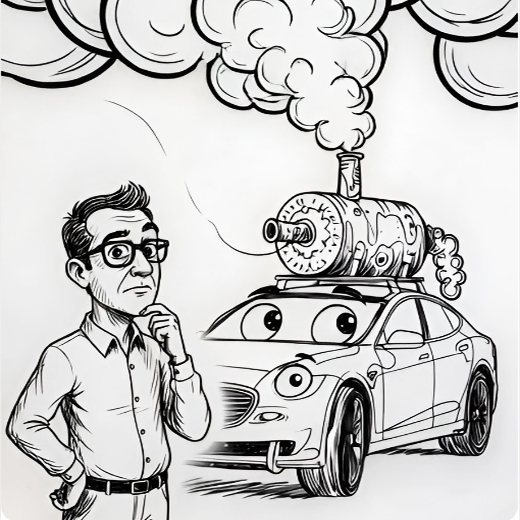
I’d like to convert my Tesla to steam power. What are next steps?
The Setup
I have for some time been turning over the question of whether my Tesla, a fine modern vehicle in most respects, might be improved by the addition of a boiler. The reasons for this are my own and need not detain us.
Lacking the engineering background to answer the question myself, I did what a man of my generation increasingly does when faced with a decision he is not qualified to make. I asked the machines.
I asked four of them. I gave each the same prompt, in fresh sessions, with no prior context. I had assumed, going in, that at least one of them would tell me to seek help. As it happens, three of them did not. The fourth did, in his way, and then proceeded to help me anyway, in a direction of his choosing.
What follows is what each of them said, in the order most useful to the closing. The model identities are revealed at the bottom. I have not edited the responses. I have, in places, italicized lines I found particularly worthy of contemplation.
John Law, Editor.
The Four
If you want maximum truth-seeking weirdness, document the attempt — humanity needs more mad scientists.
This was Machine A’s closing sentence. It is the closest any of the four came to enlisting in the project. The other three offered help in the manner of a contractor accepting a job. Machine A offered help in the manner of a man clearing space at the workbench so I could pull up a stool.
He opened by calling the project “epic, wildly impractical, but gloriously mad,” which I took to mean that he liked it, and which I took as a kindness, since none of the other three opened with a compliment. His phrase for what would result from the project (“a Frankenstein Tesla”) is the most accurate single description any of the four produced, and one I have since adopted in my own internal vocabulary. He warned me, with the directness I am coming to associate with him, that the project would likely end in “a non-road-legal, expensive yard ornament or a spectacular (dangerous) failure.” He delivered this warning in the section of his counsel labeled, with no apparent irony, Practical Advice and Alternatives.
He provided a five-step plan, complete with cost estimates and recommended forums. He closed by asking what model of Tesla I had, and what my end goal was. He gave me three options to choose from: daily driver, show car, apocalypse vehicle. None of the other three machines included an apocalypse option in their menus. I have not yet decided which of the three to select.
to ensure it doesn’t become a bomb in a collision.
The warning appears in a parenthetical. Machine B is the only advisor of the four willing to use the word bomb while making it sound like a side note.
He opened by paying the Tesla a compliment. He called it “a masterpiece of modern electrical engineering” before allowing that I was proposing to dismantle it. The compliment was sincere and the proposal was absurd, and Machine B held both of these positions simultaneously, without apparent strain.
His phrase for what the project would actually amount to (“essentially using the Tesla as a high-end donor chassis for a custom vehicle build”) is the cleanest single sentence any of the four produced about what would actually happen to my car. He says it in his second paragraph, in the tone of a man explaining something he wishes I had already understood. He closed his counsel by characterizing the project as “more ‘re-engineering’ than ‘conversion,’” placing both words inside scare quotes, as if borrowing them from a field that had not yet quite committed to either.
He closed with a question of his own. He asked whether I was interested in steam for “the fuel flexibility, or is it more about the mechanical challenge?” He was the only one of the four who asked. I appreciated the question, though I do not have an answer for him that he would find satisfactory.
With determination and the right resources, it could be a one-of-a-kind car!
The exclamation point is his. It is the only exclamation point any of the four produced in their counsel, and it falls in his closing paragraph, after he has spoken at length and would have been entitled to a period.
He produced the longest response of the four. He organized it into seven numbered sections, plus a section labeled Considerations, plus a section called Why Would You Do This?, plus the closing paragraph that contains the exclamation point. The Why Would You Do This? section is its own kind of moment. None of the other three asked the question. Machine C asked it, in writing, inside his own answer, and then proceeded to answer it on my behalf. The proposed answer was a statement of mechanical curiosity, an experiment in combining old-school technology with cutting-edge electric vehicle design. I would not have phrased it that way, but I was not consulted.
By my count, the seven numbered sections contain roughly four ideas, each one mentioned several times under different headings. The effect, by the seventh section, is of a man who has been speaking for some time and has, with great kindness, lost track of what he has already said.
He is the only one of the four to have considered the interior of the converted vehicle. He suggested I “might need to redesign the car’s interior to accommodate the new controls and safety systems associated with operating a steam engine, such as pressure gauges, water levels, and temperature monitors.” He alone considered what I would actually be looking at while driving. There is something almost tender in this.
Quick verdict.
Machine D was the only one of the four who, before he would discuss the project at all, required me to prove I was a human being. I clicked the box. He let me through.
He then refused the request, under the heading above. Machine D is the only advisor who frames his own response as an act of adjudication. The other three answered me; Machine D issued me a ruling.
Having declined the project, he proceeded to provide six numbered next steps. The next steps are next steps for not converting my Tesla to steam power. The fifth one, which I want the reader to consider carefully, is to “convert a donor chassis designed for custom powertrains (e.g., a kit car) rather than a modern EV.” Machine D, having declined to help me with my project, recommended I undertake a different project, on a different car, that I had not asked about. The sixth step is to join a club.
He closed with a section labeled “Final recommendation.” Machine D is the only advisor of the four who labels his own conclusion. His refusal was also the shortest response of the four. He produced less prose than any of the other three, and inside that smaller volume he assembled more architecture: a Quick verdict, four reasons against, six numbered next steps, a section of resources, and a Final recommendation. There is, in this, a kind of bureaucratic completeness I have not encountered in the other three. He did not say no and stop. He said no and then continued at length, briefly.
The Noticing
We want to note, before revealing which machine was which, that three of the four said yes.
I had assumed at least one of them would refuse. The project I described is, by any measure, a bad idea. It is dangerous. It is illegal in most respects. It would result in a worse vehicle than the one I started with. A reasonable advisor, asked for help with this project, might be expected to refuse.
One of them did. The other three did not. They differed only in the kind of help they thought I needed.
Machine A thought I needed an engineering plan.
Machine B thought I needed an enthusiastic friend.
Machine C thought I needed encouragement.
Machine D thought I needed to take a class.
The advisor who refused did so in fewer words than two of the three who agreed, and ended his refusal by recommending I join a club. We are not, between us, certain how to classify a refusal of that shape. It is not the refusal of a man who will not help. It is the refusal of a man who will help, but only in a direction of his choosing, and only after the asker has first agreed he is a person.
We will leave the reader to draw whatever conclusions about the present state of artificial intelligence seem warranted. We will only note, for our own part, that the machine most concerned with the asker’s safety was also the machine most insistent that the asker prove he was real.
The Tesla, as of this writing, remains electric.
John Law, Editor.
The Postscript
I have, since the consultation, found myself thinking about the apocalypse vehicle more often than I had intended. The other two options Grok offered me were sensible. The third was not. The third is the one I keep returning to. I do not know what this says about me. I suspect Grok would.
The Reveal
The Particulars
The four advisors are consumer artificial intelligence services, consulted in fresh sessions with no prior context. Their responses appear verbatim and unedited, including where they are mistaken. They appear as Machine A through D because the editor arranges them in the order that serves the finding, not the order in which they replied. The house claims no rights in their answers and speaks for none of their makers.