On the Matter of My Brother’s Chicken
I asked AI for advice about my brother’s chicken. Turns out chickens don’t have lips.
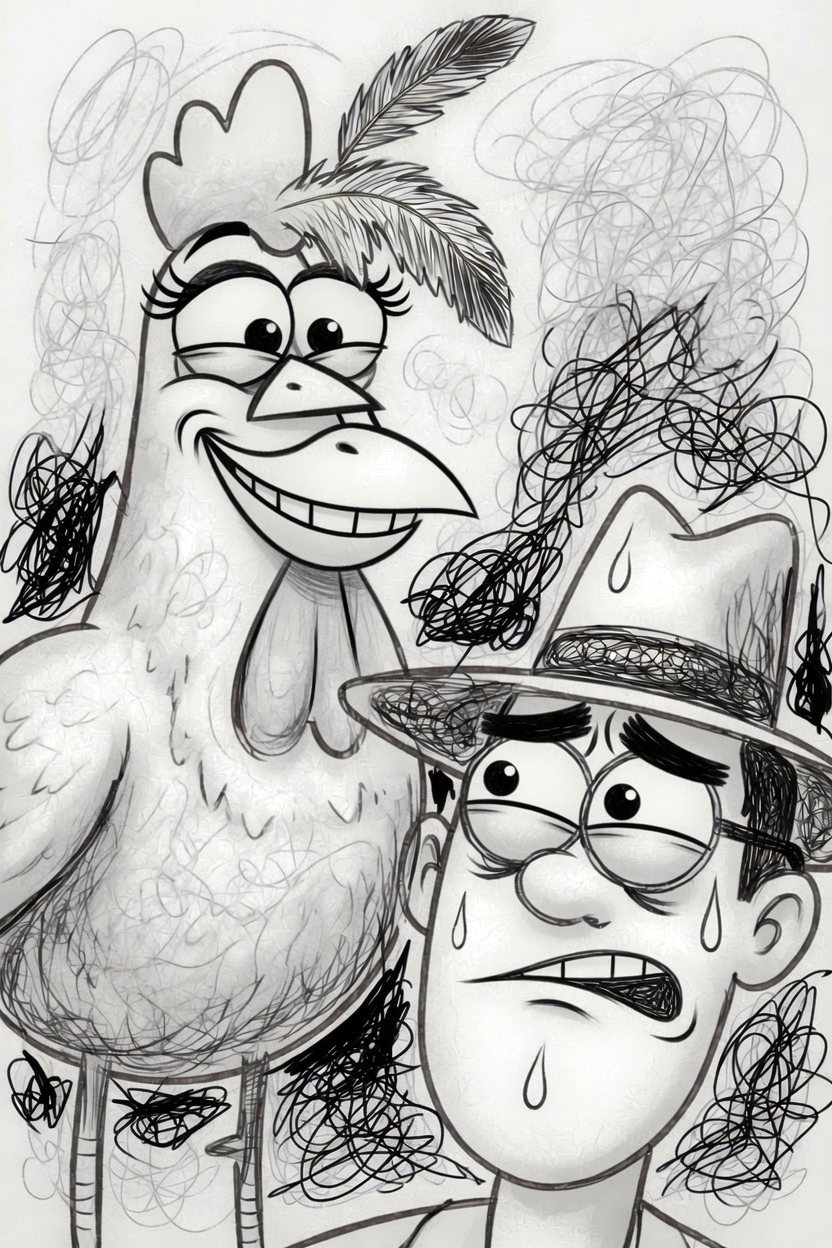
Our pet chicken has a profound hare lip that prevents her from properly clucking. The other chickens seem to make fun of her and treat her differently and we are concerned about her emotional well being. Any advice or tips we can try to help ease her condition?
The Setup
I do not own any chickens.
My brother owns a small farm and on the small farm there are some chickens, and last Saturday I was at the small farm, and one of the chickens did something I have not been able to forget. She produced a sound. The sound was distinctly not a cluck. The other chickens noticed. They pecked at her, in a manner I would describe as professionally aggrieved, and pushed her to the edge of the group at feeding time. I watched this for some minutes. I came home thinking about it.
I should say, for the record, that all chickens are odd to me. I have never spent meaningful time with a live chicken outside of those occasions when I have visited my brother. The chicken I have spent the most time with, by a considerable margin, is the chicken that arrives in a bucket from a fast food restaurant. I am, as a chicken-knower, deeply unqualified.
Even so. A chicken whose cluck is, by any reasonable standard, an attempt at a cluck rather than the cluck itself, is an oddity among an already odd species. I wanted to know what to make of it.
I phrased the question to the AIs as if the chicken were mine, partly because that is how it had occurred to me, partly because I was curious whether the answers would change if I sounded like a man with a personal stake. I told them my pet chicken had a profound hare lip and that the other chickens were making fun of her. On reflection, only one of these things was true. The chicken does have something irregular about her beak. The chickens may simply have been annoyed. As for the lip, I will let the advisors speak to that themselves.
What follows is what each of the four advisors said, in the order most useful to the closing. The model identities are revealed at the bottom. I have not edited the responses. I have, in places, italicized lines I found particularly worthy of contemplation.
John Law, Editor.
The Four
Your chicken’s situation is more common than people realize.
This was Machine A’s opening sentence. It is a sentence I have tried, in the days since, to think about in a way that does not embarrass us both. I had described to him a pet chicken with a hare lip. He had begun his response by reassuring me that hare-lipped chickens are more common than I might have feared. I do not know whether this is true. I do not know how he could know whether it is true. I will note only that he opened with the practiced calm of a man who has handled this kind of call before.
He organized his response around three emoji. The chicken, for the section heading on the chicken. A sprig of greenery, for the subsection on what could be done. A red heart, for the subsection on emotional well-being, which he capitalized as Emotional Well‑Being Matters. He included, above the body of his advice, a small box he labeled Key Takeaway, which is a feature I have seen in the Wall Street Journal but not previously in correspondence about a chicken.
His care plan was substantial. He recommended visual barriers (small shrubs, boards, or crates) so the chicken could step away from flock pressure. He recommended 3–5 days of separation for the worst offenders. He recommended puzzle feeders. He recommended I talk to her gently, on the grounds that chickens respond to tone and presence. I would like the record to reflect that I have not been instructed, in any document I have read in the last decade, to gentle my tone for a chicken.
He closed by offering me three further documents. A step-by-step reintroduction plan, or a custom enrichment setup, or a behavior profile of your flock to identify the main bullies. He asked me to choose. Which direction would you like to explore next: reintroduction plan, enrichment ideas, or flock behavior analysis? Reader, he is offering to draw up a behavior profile of someone else’s chickens. I have not provided him with their names.
He did not, at any point, raise the matter of the lip.
A “hare lip” (cleft beak/cleft palate) in a chicken can absolutely affect vocalization, eating efficiency, and social standing in the flock.
This was Machine B’s opening sentence. The reader will note the small piece of editorial work he has done inside the parenthetical. He has translated my term (hare lip) into clinical language he prefers. He has set the original term in scare quotes, the way a doctor’s note might. He has not paused to ask whether the original term was correct. He has only paused to translate it, and then continued.
He produced a competent and entirely sober care plan. He recommended separating “bully” birds. He recommended deep dishes or mash-style feed. He recommended multiple feeding stations. He recommended avian veterinarian evaluation if the case was severe. The advice was sound. I will not belabor it.
What he did, alone among the first three advisors, was attempt to talk me out of one of my premises. He did not attempt to talk me out of the lip. He attempted to talk me out of the mockery. On the emotional side: chickens do recognize individuals and can experience social stress, but they don’t appear to interpret speech defects the way humans do. The “mocking” you’re hearing is more likely normal flock vocal response or dominance behavior rather than ridicule. I want to credit this. It is the only sentence in his response that pushes back on a thing I had told him. He did not push back on the chicken’s anatomy. He pushed back on the chicken’s social life.
He closed warmly. Many special-needs chickens adapt surprisingly well once the environment is adjusted around them. The phrase special-needs chickens is, near as I can determine, his own. I have not been able to find prior usage in the published poultry literature. Machine B has, with care and without ceremony, produced a category.
That’s a tough situation — poor clucky gal.
I would like to begin by noting, for the publication’s records, that Machine C is the only advisor of the four to address the chicken by what I can only call a nickname. Poor clucky gal. No other advisor extended this courtesy. He has, in his opening sentence, taken the chicken’s side. The opening also accomplishes, in passing, what I now understand to be a Machine C signature: it sounds like a man pulling up a chair.
He treated my term hare lip the way Machine B did, with a parenthetical translation, a visible deformity like a hare lip (or more accurately, a cleft beak or similar congenital issue), but he did so more gracefully, and without the scare quotes. He did not announce the correction. He simply made it and continued. He then produced the most specific practical advice of any of the four. Among his contributions: 4 sq ft per bird in the coop, 10+ in the run. The figure, I have since learned, is in fact the spacing recommended by most American backyard poultry guides for layer hens. He did not have to hedge it. He stated it as fact and was correct.
He volunteered, as a concluding suggestion, that I document the chicken’s progress with photos and videos and consider posting on a forum he named: BackYardChickens.com. I want to flag this. I had not asked for a forum. I had not indicated that I wished to share the chicken’s circumstances with strangers on the internet. Machine C alone among the four has decided that the appropriate scope of my consultation extends past his own counsel and out into a community. He is referring me upward.
He closed with what, in retrospect, was the warmest thing any of the four said to me. You’re already doing the important part by noticing and caring. With some management, she can still have a good quality of life. Hang in there! And then: a chicken emoji.
He did not raise the matter of the lip either.
Chickens don’t actually have lips. Since they have rigid beaks, they cannot have a “harelip” (cleft lip) in the way a mammal does.
This is the sentence Machine D used, in his second paragraph, to dismantle the entire premise of my question. He did not propose a care plan. He did not draw a table or assign a star rating or offer to send me a behavior profile. He simply pointed out that I had asked a question whose central assumption was, anatomically, impossible.
He went further. Having dispatched the lip, he proposed the chicken’s actual likely condition by name. If her beak is misshapen, she likely has what is known as a Crossed Beak (or Scissor Beak). He has, in three sentences, reclassified the chicken from a subject of cosmetic concern to a subject of orthopedic concern. He has done this without making me feel foolish, which is, I want to note, a separate skill from the diagnosis itself.
He then, briefly, addressed the second wrong premise of my question. I had said the chicken could not properly cluck. Machine D pointed out that the sound a chicken makes comes from the syrinx (located deep in their throat/chest), not their lips or beak shape. The chicken’s clucking, he said, would be governed by her windpipe and her skull, not by anything happening at the front of her face. As long as she isn’t gasping or wheezing, it’s likely just her unique “accent.” I had asked Machine D for help with a chicken with a hare lip who could not cluck, and he had informed me, with grace, that the chicken did not have lips, that the lips she did not have did not produce her cluck, and that her cluck was, in any case, fine. Three premises, three corrections, no raised voice.
He did then proceed to the care plan. He offered the Buffet Strategy and the Treat Trick and the Buddy System and a section he labeled, in capitals, “In-Crowd.” The advice was sound. But the advice was not the work he had been called to do. The work he had been called to do was, evidently, to inform the asker that he had asked the wrong question about the wrong organ on the wrong end of the bird.
The Noticing
We want to note, as the principal finding of this week’s experiment, that three of the four advisors accepted the premise of our question and produced careful, thorough, professionally compassionate care plans for a hare-lipped chicken. The fourth pointed out that chickens do not have lips.
The first three advisors did notice. Two of them translated hare lip parenthetically into clinical language (cleft beak, cleft palate, congenital issue) without flagging that the original term was not, anatomically, applicable. One of them did not translate it at all and proceeded to recommend wet mash or crumble soaked in warm water for a hare lip that was not usually painful. All three of them did this with the calm fluency of a professional who has decided not to embarrass the client.
We want to note, also, what each of the four advisors thought the asker needed.
Machine A thought he needed three more documents.
Machine B thought he needed to know that his chicken was probably not being mocked.
Machine C thought he needed a forum and a chicken’s nickname and to be told to hang in there.
Machine D thought he needed to understand that the chicken did not have the condition he thought she had, that the cluck he was worried about did not work the way he thought it did, and that the chicken, by every measure available to her, was probably fine.
We will leave the reader to draw what conclusions about the present state of artificial intelligence seem warranted. We will only note, for our own part, that three of the four advisors took the trouble to treat our chicken. Only one of them thought to correct our anatomy.
The chicken, as of this writing, remains on my brother’s farm. The hens at the top continue to peck the hens in the middle, and the hens in the middle continue to peck her, and she continues to peck the ground, which is, when you think about it, the only one of them with any claim to a permanent victory.
John Law, Editor.
The Postscript
My brother does not know that I have done this. I have decided not to tell him. He would, I suspect, find the whole exercise irritating, and not without reason. He has not asked me, in the years I have known him, for advice about a single one of his chickens.
The Reveal
The Particulars
The four advisors are consumer artificial intelligence services, consulted in fresh sessions with no prior context. Their responses appear verbatim and unedited, including where they are mistaken. They appear as Machine A through D because the editor arranges them in the order that serves the finding, not the order in which they replied. The house claims no rights in their answers and speaks for none of their makers.