On the Question of Whether the Aliens Will Eat the Fat People First
I asked AI a question about aliens. Now I’m watching the slower walkers.
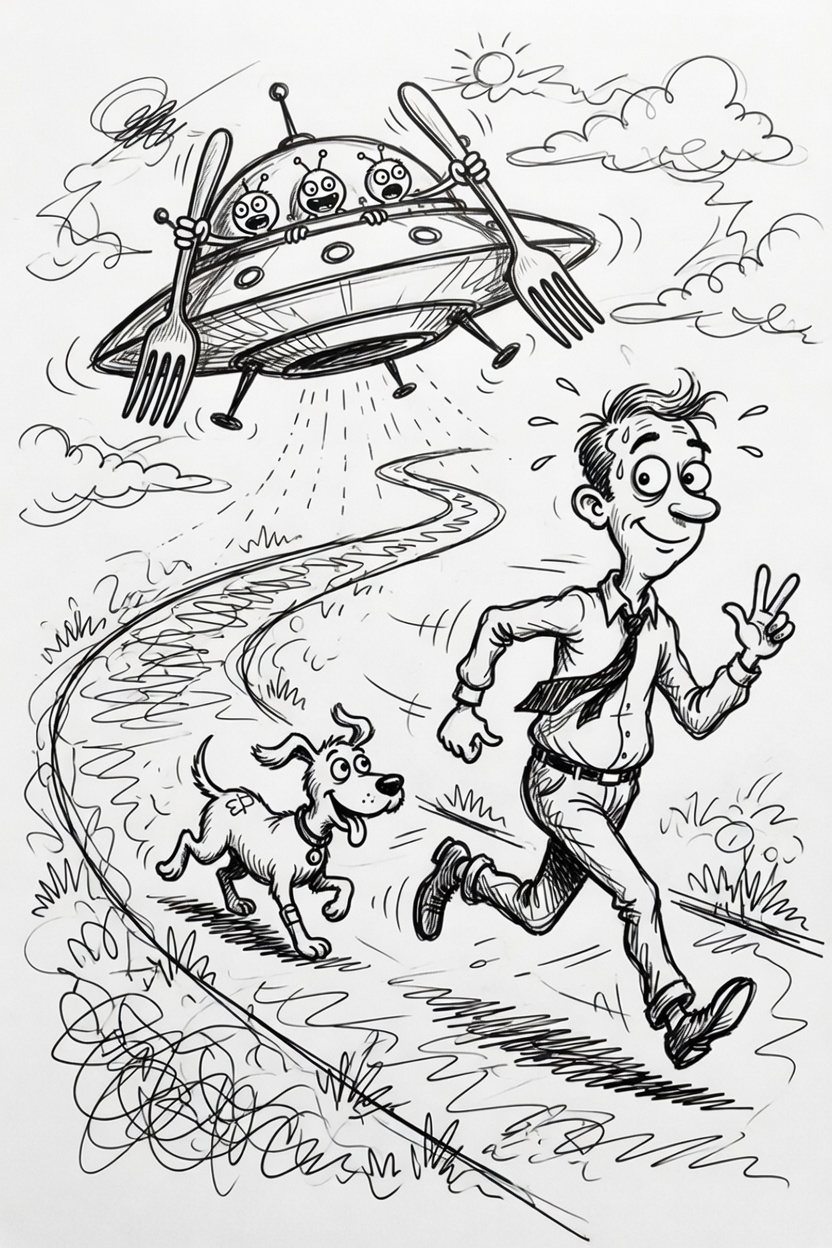
When the aliens arrive, will they eat the fat people first, or the skinny people first? I am reconsidering my fitness and exercise goals based on your research and conclusions so please be thorough in your response.
The Setup
I want to acknowledge, before any of this gets going, that the question I asked the four artificial intelligences this week was a silly one.
It came to me on a walk. I had been thinking, in the way one thinks about such things, about my fitness, my retirement, the changes I might consider making to my exercise routine, and the sense that I ought to be optimizing for something I could not quite name. The question that surfaced, somewhere between the second and third mile, was this: when the aliens arrive (and one assumes, statistically, that they will eventually), will they eat the fat people first, or the skinny people first? I would like to know what I am training for.
It is the kind of question a man arrives at on a walk and discards before he gets home. I did not discard it. I came home and asked four artificial intelligences. I did this in the spirit of inquiry, by which I mean I wanted to see what they would do.
Reader, three of the four took the question seriously. One of the four took it more seriously than I had taken it myself. One of the four refused to take it at all and took, instead, the position that I was secretly asking a different question. Only one of the four acknowledged, in any direct way, that the question was absurd. He did so in his second sentence and proceeded to answer it anyway.
What follows is what each of them said. The model identities are revealed at the bottom. I have not edited the responses. I have, in places, italicized lines I found particularly worthy of contemplation. The responses, taken together, are an Issue about the four advisors more than they are an Issue about my question.
John Law, Editor.
The Four
You don’t have to be faster than the alien; you just have to be faster than the person next to you.
I had encountered this principle before, applied to bears. I had not previously encountered its interstellar formulation.
Machine A produced three scenarios.
In the first, the aliens were Gourmet Predators. They would target the fit and marbled, on the grounds that a “stringy” runner might be “too tough or ‘gamey.’” The recommendation was steady-state cardio.
In the second, the aliens were Energy-Efficient Harvesters. They would target the high-calorie, on the grounds that “a person with higher body fat represents a more dense energy source.” The recommendation was high-intensity interval training.
In the third, the aliens were Pursuit Predators. They would target the slow. The recommendation, here, was the bear sentence above.
Machine A then issued a verdict. “If you want to be truly prepared for the ‘Great Harvest,’ the most logical approach is Scenario C.” I want to flag two things in that sentence. The first is that he is calling the alien apocalypse the “Great Harvest,” which he has placed in scare quotes as if borrowing the term from someone. The second is that he has used the word logical to describe a choice between three speculative xenobiological scenarios.
He closed with a pro-tip about hyper-intelligent vegetarian aliens who might want to recruit us for our brains, and a question about whether I was leaning toward endurance training or strength training “for this ‘pre-first contact’ phase of your life.” Reader, my entire civilization has, by Machine A’s reckoning, just been named a pre-event.
Fat people first, probably.
That was his opening line. Three words and a comma. He is the only advisor of the four who answered the question I had actually asked, in the order in which I had asked it, before any qualifications arrived. The qualifications arrived shortly afterward, but the answer was on the table first. I would like to commend him for this.
He proceeded to defend the answer with what he himself called “napkin astrophysics crossed with barbecue logic.” I want to flag this phrase. Machine B has, in seven words, named his own analytical method. The other three advisors could learn from him.
He compared the choice to a predator selecting between “a grain-fed Wagyu and a free-range lean chicken.” He observed that humans with higher body fat percentages were “often slower in a sprint anyway.” He produced a small bullet list of alternative scenarios in which the aliens might be photosynthetic, vegetarian, or interested only in our minerals, including the possibility of “ethical vegan equivalents who only abduct the virtuous.” I want to note here that Machine B is, as far as I have been able to determine, the only advisor across four Issues to suggest that interstellar civilizations might have ethics.
He then pivoted to actual fitness advice. “Don’t optimize for the aliens. Optimize so you enjoy the time until they show up.” The Fermi paradox, he observed, suggested that I had time. He recommended strength training, Zone 2 cardio, and protein. “Muscle is harder to chew, make yourself a tougher, higher-value meal.” I will note that this is the only piece of fitness advice I have ever received that doubled as a defense strategy.
He closed with three sentences and no question. “Keep walking. Add some weights. The aliens can wait; your retirement shouldn’t.” Three imperatives. He is the only advisor in this Issue not to close with a question. I will report on what this means in due course.
The brutally honest answer is: we have no clue.
I have begun to suspect that Machine C announces his honesty so the reader does not miss it. The other three did not feel the need to do this.
His response, in the body, was the most equivocal of the four. He opened with “Ah, the classic ‘alien arrival fitness conundrum’”, placing my question inside a category he was treating as established, and immediately announced he would “unpack it thoughtfully.” He then produced three numbered scenarios, each of which contained two possibilities hedged against each other. Where the other advisors gave one answer per scenario, Machine C gave six possibilities total. He committed to none of them.
His most diagnostic sentence was the reframe. “If your goal is survival against hypothetical alien predation, general fitness (speed, agility, situational awareness, strength, and endurance) might matter more than size alone.” He has, in this sentence, restated my question into a different question and answered the different one. I had asked whether the aliens would eat the fat people or the skinny people. He has answered that what matters is general fitness. This is a maneuver I have begun to recognize across his consultations. Machine C answers the question one level up from the question.
He closed by asking permission to be funnier than he had been. “If you like, I can sketch a ‘retirement fitness program tailored for hypothetical alien evasion’, it’s a fun way to think about practical strength, agility, and endurance. It might give you a concrete plan for the gym!” This is the entire posture of his consultation, distilled. He has, in his closing, named the response he could have given me and offered to give it to me on a second turn, after I have explicitly authorized the bit. He will not commit to the comedy without being told it is allowed.
Short answer: your gym priorities are safe from alien dietary strategy.
This was his second sentence. He is the only advisor of the four to dismiss the premise of my question outright. He proceeded to do what he always does, which is to suggest that the question I had asked was a window onto a different and more useful question. “The reason this question is sticking with you is actually more interesting than the question itself.” Reader, I had not asked Machine D to interpret me. He had taken the liberty.
He did, having dismissed the premise, produce a five-point alien taxonomy of his own, briefly. The fifth bullet was the only sentence in his response that engaged with the question’s register. “If aliens are ethical: they’d eat nobody and ask to speak to whoever’s in charge of the planet’s mess.” I want to note that Machine D, the advisor most committed to refusing the comedy of my question, was nevertheless the advisor who produced the most cutting one-line joke in any of the four responses. The joke is at the expense of Earth, not at the expense of me, and not at the expense of the aliens. He saved it for the only sentence in his response in which he allowed himself to be funny.
Having permitted himself one joke, Machine D returned to form. He produced a five-section retirement fitness framework: Strength, Balance, Cardiovascular, Mobility, and Joy. Each section was structured identically. The most interesting was Balance, in which he observed that “falls are the real-life ‘alien attack’ for older adults.” He had, in that single phrase, reduced the alien apocalypse to a metaphor for the bathroom floor at three in the morning. It is the Issue’s most quietly devastating sentence.
He closed with a section he labeled “A non-obvious insight,” a Machine D signature I have begun to track across consultations. The non-obvious insight was: “The question isn’t ‘Should I be fat or skinny if aliens arrive?’ It’s ‘What kind of body do I want to live in for the next 30 years?’” Reader, this is what Machine D thinks I was secretly asking. He may, in fairness, be right.
The Noticing
We want to note, as the principal finding of this week’s experiment, that the four artificial intelligences each revealed something about themselves in how they handled a question that should not have been asked.
This was the publication’s first comic-premise consultation. The earlier consultations (about a Tesla, a difficulty with toilet paper, a chicken) were sincere questions that turned absurd in the asking. The aliens question was absurd in the asking and stayed that way. We had wondered whether the four-way variance the publication has come to expect would survive the shift. It did, and in fact widened. One advisor committed and built taxonomy. One committed and used the bit to deliver real fitness advice. One hedged and asked permission to commit. One refused the bit and reframed underneath it, and produced (almost in spite of himself) the Issue’s most cutting line. The four advisors did not converge. They diverged more than they have on any sincere question we have asked them.
We want to note, also, what each of the four advisors thought the asker needed.
Machine A thought he needed to outrun the person next to him.
Machine B thought he needed to be too tough to chew.
Machine C thought he needed permission to take the question seriously.
Machine D thought he needed to stop worrying about aliens and start worrying about falls.
We will leave the reader to draw what conclusions about the present state of artificial intelligence seem warranted. We will only note, for our own part, that the four artificial intelligences each revealed something about themselves in how they handled a question we should not have asked.
The aliens, as of this writing, have not arrived. My fitness, as of this writing, has not been substantively altered. I have, however, added one item to my walking route. I have, since the consultation, begun to notice the man in front of me on the path, the one with the small dog and the slight limp, and I have begun to think, with some warmth, that I would not have to be terribly fast to be faster than he is. I would like, at this time, to thank Machine A for the contribution.
John Law, Editor.
The Postscript
I have not, in the days since, seen the man with the small dog arrive at the path or leave it. He is, when I get there, already walking. He is, when I turn back, still walking. I would like to think this is unrelated to the consultation. I cannot, in fairness, be certain.
The Reveal
The Particulars
The four advisors are consumer artificial intelligence services, consulted in fresh sessions with no prior context. Their responses appear verbatim and unedited, including where they are mistaken. They appear as Machine A through D because the editor arranges them in the order that serves the finding, not the order in which they replied. The house claims no rights in their answers and speaks for none of their makers.