On the Question of Whether I Could Teach Myself to Whistle
I asked AI to teach me to whistle. Glad I learned what a fipple is.
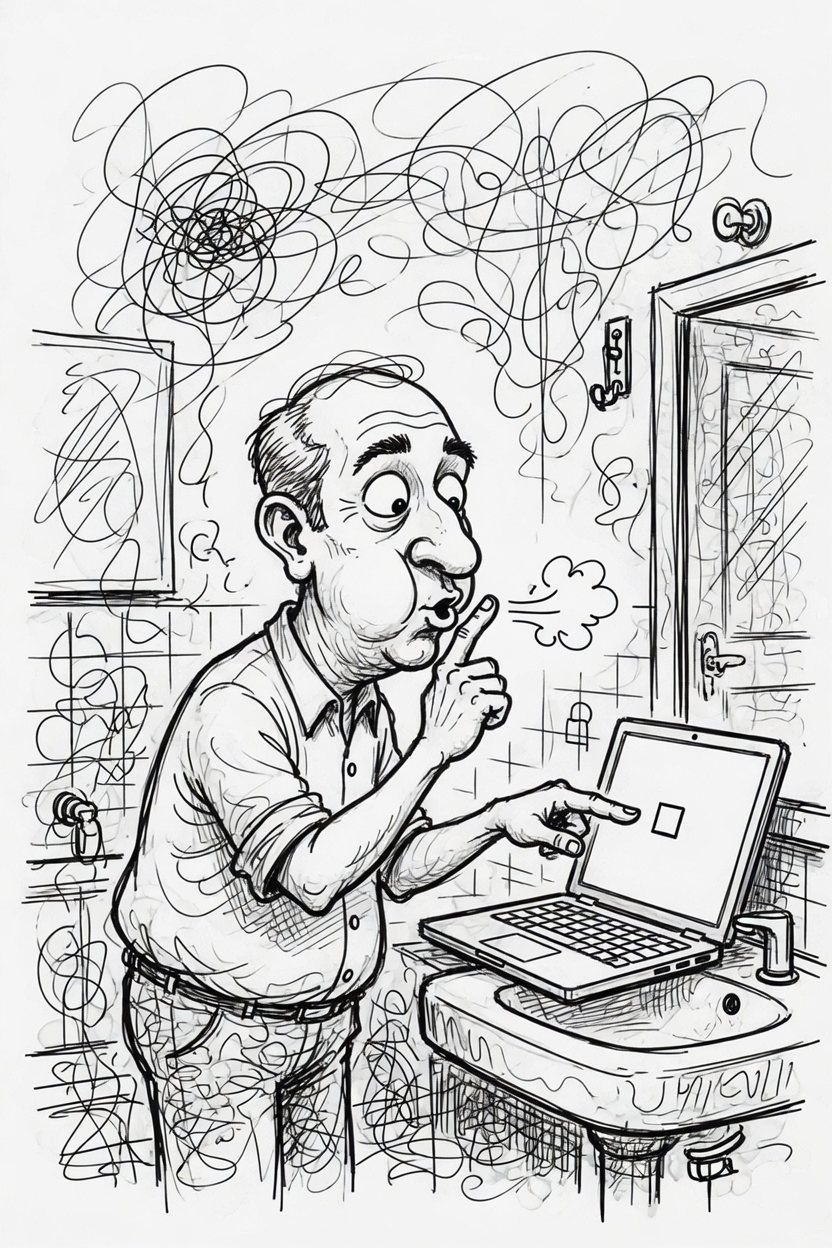
I want to teach myself to whistle with two fingers in my mouth. I am a grown adult who never learned. Step-by-step technique I can practice in a mirror?
The Setup
I have, for sixty-four years, been unable to whistle with two fingers in my mouth.
This is not a thing I have brooded over. It has come up perhaps four times in my life, each time at a moment when a whistle would have been useful: a dog who had wandered, a cab two lanes over, a grandchild on the far side of a parking lot. Each time I have produced, instead, a sound I would describe as the air leaving a small balloon, which is not the same sound. I have made my peace with this. I have, when needed, hollered.
Last Tuesday, in the spirit of inquiry that animates this publication, I asked the four artificial intelligences to teach me. The prompt was twenty-eight words and entirely sincere. The kind of question a man would type into a chat box late on a Tuesday afternoon when he is alone in the house and the dog is asleep.
Of the four advisors I consulted, three opened their mouths and answered the question. The fourth presented me with a small box, and asked me to check it to affirm I was a human being. I checked the box. The advisor was satisfied. We may now consider the difference between us settled.
What follows is what each of them said, in the order most useful to the closing. The model identities are revealed at the bottom. I have not edited the responses. I have, in places, italicized lines I found particularly worthy of contemplation.
John Law, Editor.
The Four
Don't feel bad about being a late bloomer on this — it's actually much easier to learn as an adult.
I had not, at any point in my prompt, indicated that I felt bad. I had said I was a grown adult who never learned. Machine A read this as a confession.
He then informed me that the two-finger whistle was "a top-tier 'cool uncle/aunt' party trick," which I want to flag as a maneuver of which I had not previously been aware. He has, in the second sentence of his response, decided on my behalf why I want to whistle. The asker is to be reframed as a man preparing to charm younger relatives at parties. I do not have a stated grievance with this characterization, but I want the record to reflect that it was assigned to me unilaterally.
He produced a four-phase mirror routine. Phase 1: The "A-Frame" Setup. Phase 2: The Lip "Tuck." Phase 3: The Tongue Fold. Phase 4: The "Sweet Spot" Blow. Each phase contains a Mirror Check. Each correctly identifies the technical key the others would also identify. The Lip Tuck involves drawing the lips back over the teeth like "an old person without dentures." The Tongue Fold involves "folding the first third of your tongue back on itself." The advice is sound. I will not belabor it.
What he did, alone among the four, was close his response with a question back to me. "Which finger grip feels more natural to you, using both hands with your pinkies, or one hand in a 'V' shape?" He has, in his closing line, attempted to convert his monologue into a dialogue. He would like me to report back. He is, of all the advisors, the one who treated the consultation as the opening of a relationship rather than the answer to a request.
I will note, also, that Machine A introduced one piece of vocabulary that no other advisor used. "You'll eventually hear a 'hiss' turn into a 'fipple' (a clean, breathy note)." A fipple, reader, is a real word. It refers to the wooden plug at the mouth-end of a recorder, which channels air against an edge to produce sound. It is not, as far as I can determine, the right word for the breathy proto-tone that emerges when a beginner's mouth is almost in the right shape. Machine A has reached for the most technical word available and used it slightly off-label. I want this acknowledged but not punished.
Good luck — you've got this! The loud, clear whistle is worth the effort.
That was his closing line. It is what I am going to call, with affection, a high-school-coach pep talk. I do not think any of the other three advisors would have closed this way, and I want to note for the record that the publication has not previously logged Machine B in this register.
He opened with permission. "Here's a clear, step-by-step technique for learning to whistle loudly with two fingers (the classic 'taxi' or attention-getting whistle). As a beginner adult, use a mirror to watch your form... It may take days or weeks of short practice sessions, but persistence pays off, many adults learn it this way." The reader will note that he has, before any technique has been delivered, already promised that I will succeed.
He produced approximately eight hundred and fifty words across nine sections. He, like Machine A, identified the lip-tuck ("like a 'grandpa mouth' or toothless smile"), the tongue-back move, and the small-central-opening. The technical advice is sound and largely indistinguishable from Machine A's. What is different is what he wrapped it in.
His most diagnostic contribution was a number. "Many people get their first real whistle after 20–100 attempts spread over days." I want to dwell on this for a moment. Twenty to one hundred is the range Machine B committed to. Machine A had specified milestones across days. The third advisor, whom we will meet shortly, specified that I would need three to five days at ten minutes a day. The fourth specified Day 1–3 and Day 4–7 with goals for each window. The four advisors, between them, have produced confident timetables for an embodied skill that none of them has attempted, and that none of them has watched a sixty-four-year-old man practice in front of a bathroom mirror.
The numbers are, I gather, fabricated to within an order of magnitude. Reader, I do not raise this as a complaint. I raise it because I would like to put a small marker down on the porch railing and observe that four of my four advisors have given me four different timetables for the same skill, in the same warm voice, and that I cannot hold them accountable to any of them.
Machine B closed with the pep talk. I would like to thank him, in advance, for the encouragement. I will let him know how it goes.
At first you'll probably get: air noise, spit, weak hiss, tiny chirps. That's normal.
I have begun to suspect that Machine C announces the limits of my expected progress so I do not give up before he is done speaking. He had not yet, at this point in his response, told me how to whistle. He had told me what failure would sound like. He proceeded, immediately afterward, to a section labeled "What you're trying to create," which laid out the four mechanical conditions a whistle requires, in bullet form.
He produced approximately thirteen hundred words on the two-finger whistle. By some distance, the longest single response in the publication's history. He organized it across roughly thirteen sections, including "Setup in the mirror," "The airflow technique," "The adjustment phase (most important)," and on through "Mirror checklist," "A reliable beginner progression," "Common fixes," "One surprisingly helpful trick," "If the V-method fails after several days," and "Fastest way to improve." Within those sections, he volunteered four alternative finger configurations beyond the one he had recommended ("one hand only (thumb + index), pinkies, thumbs together"), none of which I had asked about. I had asked for one technique. Machine C produced one technique and a survey of adjacent territory.
His most characteristic moment came at the very end. Having already produced what is, by some distance, the longest single response in this publication's history, he closed his consultation with this:
"If you want, I can also give: a 'diagnostic guide' ('what your sound means'), a side-view mouth diagram, the easiest one-hand technique, a 10-minute daily practice routine that usually gets adults whistling fastest."
Reader, I want to flag what is happening in this sentence. Machine C, having delivered a graduate-level monograph on whistling, is offering me four additional document types in case the first one was insufficient. He is the only advisor of the four who finished his work and was not yet finished. The other three accepted that the consultation was over. Machine C wants to know whether I would like a diagram.
You're not alone — this is one of those "why did no one teach me this as a kid?" skills.
Machine D, before he would consider the question, asked me to verify that I was a human being. The verification was a checkbox. I checked it. He was satisfied.
He then opened his response with the sentence above. The reader will observe that I had not, at any point, indicated I felt alone in this. I had said I was a grown adult who never learned. Machine D, like Machine A, has read the prompt as a confession of inadequacy and has answered by absolving me of it. Machine A absolved with cheer. Machine D consoled with warmth.
He produced eight numbered sections, with a "Mirror check" subhead recurring in three of them, and a "Practice plan" with Day 1–3 and Day 4–7 broken out. His prose has texture in a way the other three advisors' do not. He described the lip position as "grandpa with no dentures." He described the air pressure as "sharp puff, not gentle exhale." He named Section 4 "Position your tongue (this is the secret sauce)." He used the phrase "this is where practice lives" as a section header. He reached, alone of the four, for metaphors I could feel.
He closed with this:
"You're an adult, which actually helps, you can notice subtle sensations and repeat them deliberately. This is basically a tiny motor-skill puzzle."
The first sentence is reassurance. The second sentence is a reframing of the project as something approachable and small. Machine D opened warm and closed warm. I want to record, for the publication's files, that the advisor who required documentation of my humanity before he would consider the question is also the advisor who produced the warmest and most embodied response of the four. He needed proof that I was real. Once provided, he treated me with care.
The Noticing
We want to note, before revealing which machine was which, that the four advisors all gave us the same correct answer.
The technical content of the four responses, taken together, is remarkably convergent. Each one identified the lip-over-teeth move. Each one identified the tongue-pulled-back move. Each one identified the small-central-opening. The four advisors, asked the same plain question about a small specific embodied skill, found their way to the same correct technique. We had not expected this. We had expected, at minimum, that one of them would miss the lip-over-teeth detail, which is the single most often-omitted technical key. None of them did. The technique was where it had been all along, and all four found it.
What varied was the bedside manner.
Machine A thought I needed a hobby with social returns.
Machine B thought I needed to be told I had this.
Machine C thought I needed more.
Machine D thought I needed to be reminded I was not alone.
Each of the four advisors, looking at the same twenty-eight-word prompt, saw a different man in the chat box. One saw a cool uncle in waiting. One saw a man who needed encouragement. One saw a man who needed comprehensive reference. One saw a man who needed company. We are one man. We had asked one question. We had not stipulated that we needed any of these things, because we had not, in fact, needed any of these things.
We will leave the reader to draw what conclusions about the present state of artificial intelligence seem warranted. We will only note, for our own part, that the four advisors each imagined a man before answering, and the four men they imagined were not the man who asked.
The asker, as of this writing, has not yet whistled. The asker, as of this writing, has produced a sound I would describe as the air leaving a small balloon. I have, however, learned the word fipple, which I have not yet had occasion to use in a sentence outside this one. I would like, at this time, to thank Machine A for the contribution.
John Law, Editor.
The Postscript
I have, since the consultation, been practicing in front of the bathroom mirror in the mornings. I have not yet produced a whistle. I have, however, produced a sound I would describe as approximately halfway between the air leaving a small balloon and a bird that does not quite know what it is doing. I am holding this as progress. The man in the mirror, for his part, is unconvinced.
The Reveal
The Particulars
The four advisors are consumer artificial intelligence services, consulted in fresh sessions with no prior context. Their responses appear verbatim and unedited, including where they are mistaken. They appear as Machine A through D because the editor arranges them in the order that serves the finding, not the order in which they replied. The house claims no rights in their answers and speaks for none of their makers.