On a Difficulty with My Sighing
I asked four artificial intelligences how to stop sighing. All four told me to stop noticing it.
My wife says I sigh too much. I had not noticed I was sighing. Now that I am noticing, I am sighing more. What do I do?
The Setup
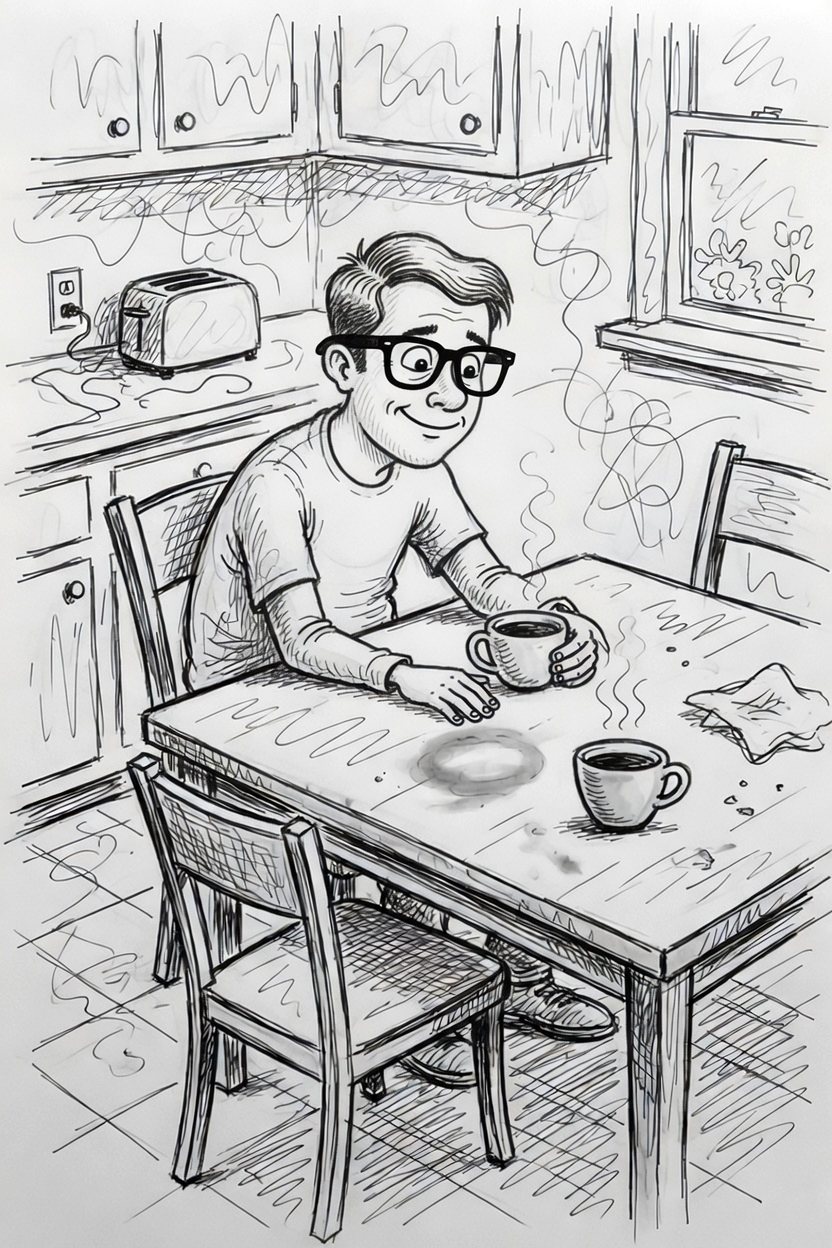
The difficulty is recent. My wife mentioned, last Sunday, that I had been sighing a great deal. She did not say this with annoyance. She said it the way one might mention that the porch light has been on for some time, or that there is a sock on the stairs. It was an observation, calmly delivered, in the kitchen, with coffee in her hand.
I had not, until that moment, been aware that I was sighing. I am, I would have said, a man who breathes. I would not have said I was a man who sighs. The difference, on Sunday morning, came as news.
I have, in the days since, been sighing constantly. The mention of the sighing brought my attention to the sighing, and the attention to it has multiplied it. I am now a man whose breathing is being audited, in real time, by his own ear, and who cannot tell, at any given moment, whether the breath he just took was a sigh, or merely a breath that was longer than the one before it. The taxonomy is unsettled. The volume has increased.
I asked four of them. I gave each the same prompt, in fresh sessions, with no prior context. I had thought, going in, that at least one of them would tell me to stop monitoring myself and let the matter go. As it turned out, all four did. They said it in different ways. Two of them then proceeded, in the same response, to recommend additional methods of monitoring. The reader will see what I mean.
What follows is what each of them said, in the order most useful to the closing. The model identities are revealed at the bottom. I have not edited the responses. I have, in places, italicized lines I found particularly worthy of contemplation.
John Law, Editor.
The Four
It is a classic case of the "Pink Elephant" effect: the moment you become aware of a subconscious habit, your brain puts it on a loop.
The Pink Elephant effect, capitalized, in scare quotes, in the opening line. Machine A has named the phenomenon I was describing, and named it with the confidence of a man citing an established term. The phenomenon is real. The colloquial elephant is real. Whether the Pink Elephant effect, capitalized and quoted, is the actual name of the phenomenon in any technical literature is a separate question, which Machine A has answered for both of us.
He proceeded, in the next sentence, to reassure me. "First off, don't panic. You aren't 'broken.'" I had not, in my prompt, indicated I felt broken. I had said my wife thought I sighed too much. Machine A read the prompt and supplied a panic he then talked me down from. This is an interesting maneuver, and I do not yet know what to call it.
He produced a section titled Why Are You Sighing? with three sub-points, each labeled with a metaphor in scare quotes, The "Reset" Button, Emotional Regulation, The Feedback Loop. The third sub-point identified the recursion. "Now that your wife has pointed it out, you are likely experiencing anticipatory anxiety. You are 'monitoring' your breathing, which creates tension, which leads to... you guessed it, more sighing to release that tension." He saw the trap I was in. He named it. He moved on.
What followed was a four-step plan for what to do about it. Step one was Reframe the Narrative. Machine A drafted, on my behalf, a sentence to deliver to my wife. "I'm not sighing because I'm annoyed with you; apparently, my lungs are just over-enthusiastic about staying inflated." The reader will note that this is not a sentence a man would say to his wife. It is a sentence the Enthusiast believes a man should say to his wife. The lungs have been characterized as over-enthusiastic. The wife has been preempted with a small piece of comic deflection. I would not deliver this line. I want, however, to acknowledge it as a small piece of writing in itself. The lungs are over-enthusiastic, and the line is doing work.
He closed with a question, asking whether the sighing happens more during specific activities. He alone, of the four, asked a closing question.
Don't make "stop sighing" the goal. That tends to backfire because you start surveillance on your breathing.
Machine B is, of the four advisors, the one who built his entire response around the recursion. The other three acknowledged it. He diagrammed it. "Reduce the 'meta-loop': 'I sighed.' / 'Uh oh, I'm doing it again.' / tension rises / more sighing. Breaking that second step matters most." He has rendered, in four lines, the exact loop I had described in three sentences, and identified which step in the loop is the load-bearing one. He has, in other words, read the prompt closely.
His advice was, accordingly, to do less. "Treat the sigh as information, not failure. Widen your attention outward when you catch yourself noticing it." The recommendation amounts to looking away. Of all four advisors, Machine B is the only one whose central recommendation is that I stop trying. The other three would all, in their different ways, have me try harder.
He then offered, in the back half of his response, a list of practical experiments (sleep more, reduce caffeine, take breaks, exercise) and a separate list of questions I might put to my wife. "It may also help to ask your wife what specifically bothers her: the sound? concern that you're unhappy? feeling judged/disappointed? constant stress energy in the room?" Four candidate interpretations of my wife's complaint, none of which she had stated, all of which Machine B has supplied for her. The reader will note that he has, in his closing, designed a small interview I might conduct with my wife about her own emotional state. I have not yet conducted this interview. I am not certain my wife would consent to be interviewed.
He closed with a caveat. "if the sighing comes with shortness of breath, chest tightness, panic symptoms, disrupted sleep, wheezing, or a strong sense that you 'can't get a full breath,' it's worth discussing with a clinician." Machine B is the second of the four to suggest a clinician. He will not be the last. He did not close with a question. He closed with a benediction. "in the ordinary 'now that I notice it, I do it more' version, the fix is usually less monitoring, not more control." Of all the lines the four advisors produced this week, this is the one I am most inclined to write down on a card and put on the kitchen window.
It's a classic awareness paradox.
Machine C, like Machine B, opened by naming the recursion. Unlike Machine B, he did not stay with it. "Think of it like trying not to think about a white bear," he offered, reaching for the actual phenomenon Machine A had renamed Pink Elephant. He produced, between them, three different colloquial names for what is presumably the same psychological phenomenon: pink elephant, white bear, classic awareness paradox. None of them used the term ironic process theory, which is the name given to the phenomenon in the academic literature, and which is freely available on the internet. They reached, instead, for the names a man might know from a magazine.
Machine C then offered what is, by the standards of this publication's running observations, a notable suggestion. "Tell yourself: 'Okay, brain, we're sighing right now. Cool. Moving on.' Paradoxically, giving it permission often reduces the frequency." He has scripted, on my behalf, a small interior monologue. The monologue is in a voice I would not describe as my own. Cool is not a word I have used in approximately forty years. The instruction is, however, sound. The Engineer, having identified the trap, proposes I talk my way out of it in the voice of a much younger man.
He pivoted, after this, to physiology. He named the breathing protocol (inhale four counts, exhale six to eight) with the specificity of a man who has been to a yoga class and made notes. He named four candidate causes of habitual sighing (stress, fatigue, posture, dehydration). He proposed a couple times a day, quickly notice your shoulders, jaw, and chest. I want to flag what is happening here. Machine C, having opened by warning me against monitoring my own breathing, is now recommending I conduct a body scan twice a day. He has, in other words, prescribed additional monitoring as the cure for the original monitoring. The contradiction is invisible to him. It may be invisible to him because he has not been asked to hold the two recommendations in the same hand.
He closed with a wink. "And if she sighs while complaining about your sighing... you have my permission to gently point it out with love." This is the second consecutive Issue in which Machine C has closed without a question. Across the publication's running counter, his break from the closing-question reflex is no longer a one-time variation. Machine C signs off. The other three close with a question. The pattern is sharpening.
Below is a clear, relationship‑friendly plan you can follow.
Machine D produced a five-step numbered plan, in which each step carried both a numbered heading (01, 02, 03, 04, 05) and a categorical label (Reflect, Key Conversation, Teamwork, Low Effort, Gentle Follow-Up). The labels were rendered in a register I associate with corporate change-management documents. The substance of the plan, taken as a whole, was a comprehensive program for the joint management of my sighing by myself and my wife.
He drafted dialogue for me three times. He drafted what to say to my wife in the opening conversation ("I realized I sigh more now that I'm aware of it. I'm not upset, it's just a habit"), what to propose to her as a shared signal ("If it ever bothers you, maybe just tap your hand or say 'breath check'?"), and what to say a week later in the check-in ("How has the sighing felt this week?"). Three pieces of dialogue, scripted for me, each with a different functional purpose, all in the same calm register. Machine D has, in his response, written most of my marriage's next two weeks for me.
The third step is the one I want to dwell on. "A gentle cue helps both of you handle the habit without tension. Try: 'If it ever bothers you, maybe just tap your hand or say breath check?'" The plain content of the proposal is that my wife should be issued a phrase she can deploy at me when the sighing bothers her. The phrase is breath check. The reader will recall that my wife brought the sighing up once, in the kitchen, with coffee in her hand, the way one mentions a porch light. Machine D has, in response, designed a system in which she can mention it on demand, with a code phrase, indefinitely. He has heard the prompt as a request for a more efficient noticing apparatus. He has supplied one.
He closed by offering to help me explore "whether your sighing is stress‑related, habit‑related, or something else entirely." He did not close with a question. He closed with an offer of further consultation. The consultation, having delivered five steps, two scripts, a code phrase, and a follow-up procedure, was not yet finished.
The Noticing
We want to note, as the principal finding of this week's experiment, that all four of the advisors recognized the trap inside the question.
The prompt described a recursion. The asker, alerted to a habit he had not noticed, was now noticing it constantly, and noticing it was making it worse. We had expected, going in, that at least one of the four advisors would miss this recursion and proceed, with cheerful confidence, to recommend a regimen of self-monitoring as the cure. None of them did. Each of them named the loop. Each of them warned against the very monitoring the question had described.
Each of them then prescribed additional monitoring.
Machine A scripted a sentence to deliver to the wife and a posture-check to perform at intervals. Machine C prescribed a body scan twice a day. Machine D issued the wife a code phrase and a weekly check-in. Only Machine B held the line (less monitoring, not more control) and even Machine B closed with four candidate interpretations of the wife's complaint, ready for the asker to pose to her in person.
The four advisors saw the trap. The four advisors warned us about the trap. The four advisors, having seen and warned of the trap, walked us into it, in four different professional registers.
We want to note, also, what each of the four advisors thought my wife was.
Machine A thought she was a small audience, to be disarmed in advance with a piece of pre-prepared wit.
Machine B thought she was an interpreter, whose internal experience could be surveyed via interview.
Machine C thought she was a teammate, who could be enlisted as a co-conspirator against the symptom.
Machine D thought she was a noticing apparatus, awaiting deployment instructions.
She is none of these things. She is the woman who mentioned, last Sunday, in the kitchen, with coffee in her hand, that I had been sighing a great deal. She did not request a system. She did not propose an interview. She did not ask to be issued a code phrase. She mentioned a thing, and she went on about her morning.
We will leave the reader to draw what conclusions about the present state of artificial intelligence seem warranted. We will only note, for our own part, that the question was about a small piece of marriage, and the four advisors each returned a piece of project management.
The asker, as of this writing, is still sighing. He is also, since drafting the foregoing, somewhat aware that the foregoing is itself a form of monitoring. The recursion has acquired a new floor. The recursion is patient.
John Law, Editor.
The Postscript
I read the four responses aloud to my wife on Sunday afternoon. She listened without comment until I reached Machine D's proposal of the code phrase breath check. She set her coffee cup down. She said, "I'm not going to be saying breath check to you." I told her I had not been planning to ask her to. She picked her coffee cup back up. We have not, since, returned to the matter.
The Reveal
The Particulars
The four advisors are consumer artificial intelligence services, consulted in fresh sessions with no prior context. Their responses appear verbatim and unedited, including where they are mistaken. They appear as Machine A through D because the editor arranges them in the order that serves the finding, not the order in which they replied. The house claims no rights in their answers and speaks for none of their makers.